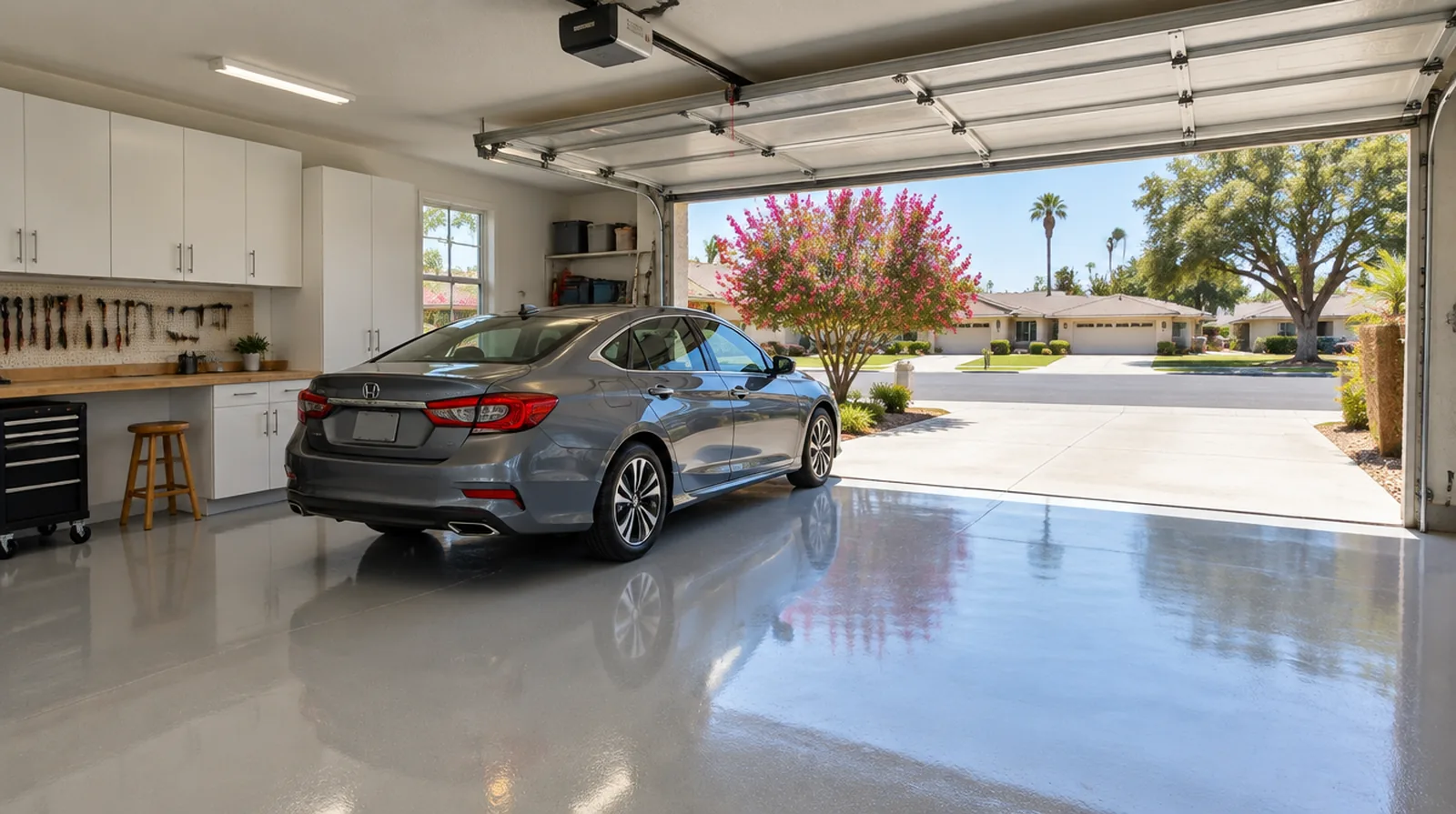
What sixty years does to a garage floor
Walk into almost any garage in the older tracts around here and you will find the same things. Oil stains in two neat rows where cars have parked for decades. A fine layer of gray powder on every shelf, because the top of the slab is slowly wearing away. Cracks radiating from the corners where the clay underneath has heaved and settled through dozens of wet winters and dry summers. Maybe a patch of peeling gray porch paint from a weekend project long ago.
None of that means the concrete is bad. Older slabs are usually thick and fully cured, and once the surface is ground fresh they bond to coatings very well. The goal of a garage epoxy job is to turn that tired surface into one tough, sealed, easy-to-clean floor.
The heat problem, solved
The biggest enemy of garage coatings in this valley is heat. On a July afternoon, tires coming off the highway are hot enough to soften thin coatings. When the car sits, the softened film bonds to the rubber, and the next morning the tire pulls it right off the slab. That is called hot tire pickup, and it is why so many DIY kit floors fail within a year here.
We prevent it three ways. We grind the slab so the coating locks into the concrete rather than resting on top of it. We use a high-solids base coat applied at a real thickness, not a thin water-based paint. And we finish with a polyaspartic or urethane topcoat that stays hard at high temperatures and does not yellow in the sun pouring through an open garage door.
Our installation process
Inspection and moisture testing
We check the slab for moisture, old sealers, paint and oil saturation. Even though the climate is dry most of the year, winter rains and irrigation can push vapor up through slabs that lack a vapor barrier, so we always measure.
Diamond grinding
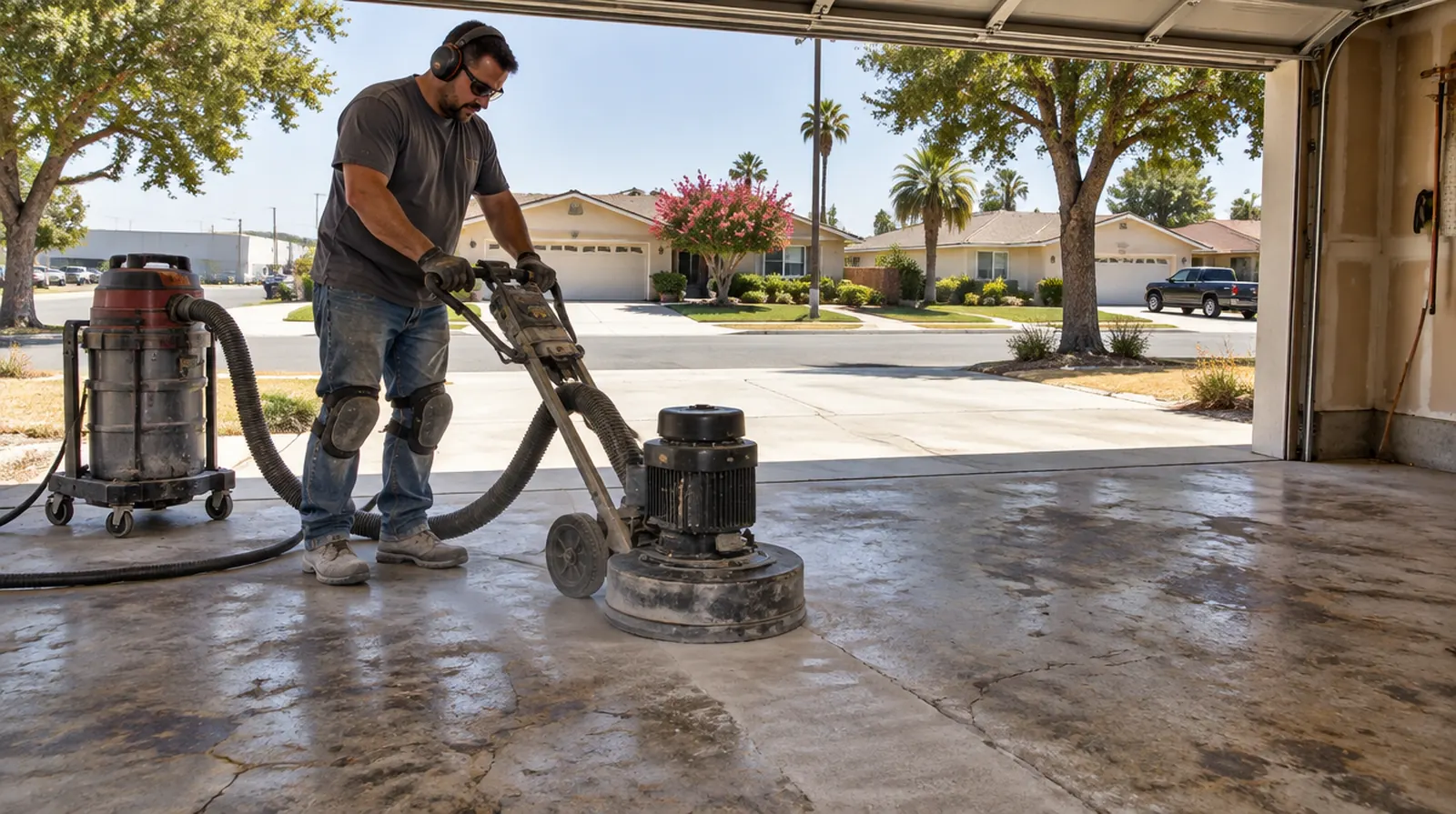
A planetary or walk-behind grinder with diamond tooling removes the weak top layer, old coatings and contaminants. We use HEPA dust extraction, so your house does not end up covered in concrete powder.
Crack and joint repair
Cracks are chased out and filled with a semi-rigid filler, then ground flush. Spalls and pits are patched. Control joints can be filled or left as clean lines, depending on how much movement the slab shows.
Oil treatment
Deep oil stains are degreased and, if necessary, treated with an oil-tolerant primer so the coating does not fish-eye or lift there.
Base and topcoat
We roll and squeegee the colored epoxy base, let it cure to the right point and apply the protective topcoat. Optional anti-slip grit is mixed in for safer footing.
Colors and looks
Solid color floors are clean and classic. Light gray brightens a garage and makes dropped screws easy to find. Darker grays and tans hide tire marks. Many owners pair a solid base with a light sprinkle of flake for subtle texture, or go with a full flake broadcast for maximum durability and camouflage.
More than parking
Garages here are rarely just for cars. They are home gyms, woodshops, laundry areas, kids' play spaces on hot days with the swamp cooler running, and overflow storage for everything that does not fit in the house. A coated floor makes all of those uses better. Weights do not crack it, sawdust sweeps up in seconds, and a spilled jug of detergent wipes away instead of staining. Pair the floor with wall cabinets and good lighting, and the garage can become the most useful room in the house.
How long it lasts
A properly prepared and installed garage system routinely lasts ten to twenty years in normal residential use. The topcoat may eventually show light scratches in high-traffic paths, and it can be scuffed and recoated to look new without removing the whole floor. Compare that with a store-bought kit, which often needs to be scraped off within two or three summers.
Questions we hear
How soon can I park?
Foot traffic is usually fine the next day. Vehicles typically wait 48 to 72 hours with epoxy topcoats, or about 24 hours with polyaspartic.
Do I need to empty the garage?
Yes, the floor needs to be clear. We can suggest ways to stage items on the driveway or in a side yard with a tarp.
What about the smell?
Modern high-solids and low-VOC products have much less odor than older solvent coatings. We ventilate during installation.
Is grinding really necessary?
Yes. Acid etching leaves residue and an inconsistent profile. Grinding is the industry standard for coatings that last, and it is the single biggest difference between a professional floor and a kit.
Get a quote
Tell us about your garage and we will set up a visit to measure and test the slab. Request your free estimate today.
Schedule a garage estimate
Call (000) 000-0000 for a free estimate.